Back to All Posts
Learn about upcoming events and the latest startup news—delivered to your inbox weekly.
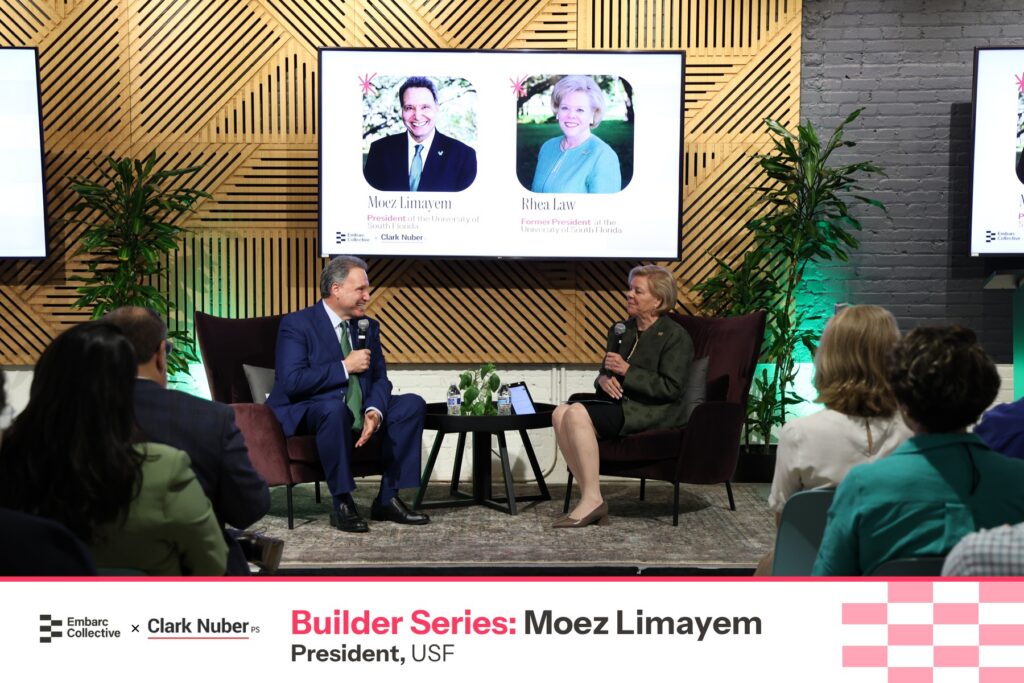
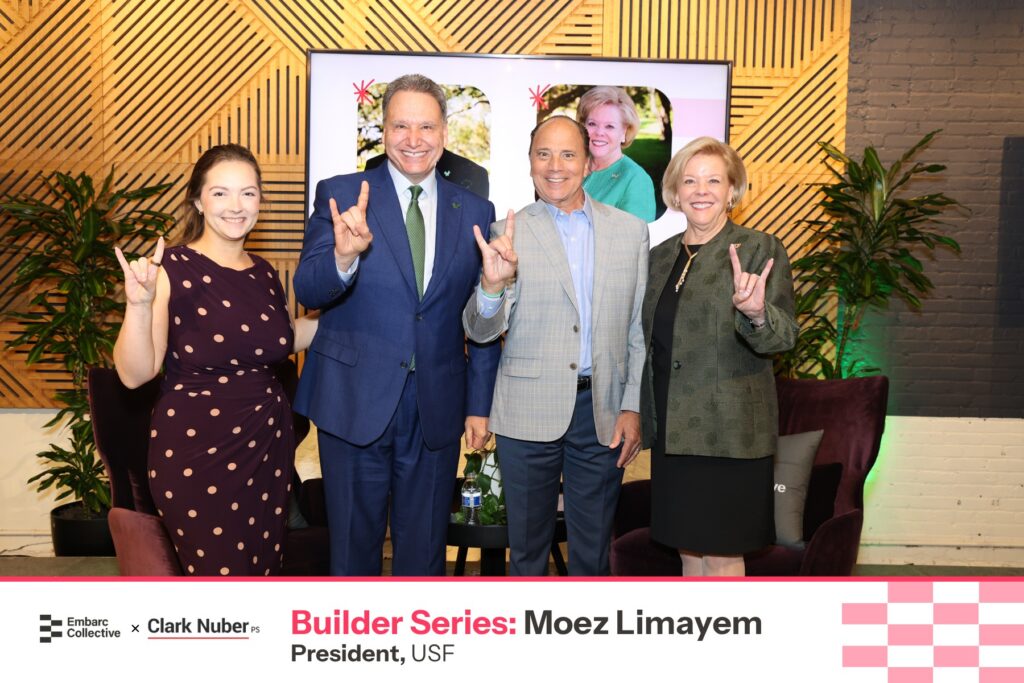
At Embarc Collective’s Q3 Builder Series sponsored by Clark Nuber, founders, operators, and community leaders gathered for a fireside chat with University of South Florida President Moez Limayem. Moderated by former USF President Rhea Law, the conversation explored leadership, the future of higher education, artificial intelligence, entrepreneurship, and USF’s growing role in Tampa Bay’s innovation economy.
Limayem returned to USF at a pivotal moment. The university is now a member of the Association of American Universities, secured $770 million in research funding over the past year, launched a new College of Artificial Intelligence, Cybersecurity and Computing, and continues to invest in major projects across the region. Yet throughout the conversation, Limayem made one point clear: past success cannot become a reason to stand still.
Listen First, Then Lead
Limayem shared a leadership philosophy rooted in listening, adaptability, and a willingness to make difficult decisions. Rather than arriving with a predetermined vision for USF, he spent his first months meeting with students, faculty, staff, and community leaders across the university’s campuses.
His approach reflects a lesson that also applies to founders: what gets an organization to one stage may not get it to the next. Leaders must stay open to feedback, communicate often, and act when change is necessary.
Limayem also spoke candidly about failure and resilience. He encouraged leaders to create environments where people can take thoughtful risks, learn quickly, and move forward. In his words, failure can be an option when teams “fail fast and fail forward.”
Rethinking Education for the AI Era
Artificial intelligence shaped much of the discussion. Limayem sees AI as both an extraordinary tool and one of the biggest challenges facing higher education.
As students gain access to technology that can generate answers, write assignments, and automate complex tasks, universities must reconsider what learning should accomplish. For USF, that means going beyond incremental changes and asking a more fundamental question: If the university were designed today, what should students learn and how should they learn it?
Limayem outlined a future centered on critical thinking, interpersonal skills, experiential learning, and entrepreneurship. USF plans to require students to complete an internship or comparable hands-on experience before graduation. The university also wants students to learn how to use AI without surrendering their ability to think independently.
That focus on entrepreneurship carries particular relevance for the startup community. As AI lowers barriers to building new products and companies, Limayem believes universities have an opportunity to equip more students to become problem-solvers, innovators, and founders.
USF Can Help Power Tampa Bay’s Innovation Economy
The conversation also focused on USF’s responsibility beyond its campuses. Limayem described the university as a critical talent pipeline and economic engine for Tampa Bay.
For companies considering where to grow, access to talent often determines the decision. USF helps the region answer that need while also producing research, intellectual property, and new technologies with commercial potential.
Limayem sees the next opportunity in turning more university research into companies, products, and economic impact. USF already ranks among the world’s leading universities for U.S. patents. Now, the goal is to strengthen commercialization and technology transfer by working more closely with entrepreneurs and ecosystem partners.
That makes partnerships with organizations like Embarc Collective increasingly important. By connecting university research and talent with founders, investors, and experienced operators, Tampa Bay can create more pathways for ideas to move from the lab into the market.
Limayem also challenged the region to sharpen its own story. Tampa Bay has made meaningful progress in working together, but he believes the community must continue defining the few strengths that truly differentiate it on a national and global stage.
For founders in the room, the broader message was clear: strong ecosystems require collaboration. Universities, startups, investors, companies, and civic leaders each bring different assets to the table. When those groups align, they can create opportunities none could build alone.
As the conversation concluded, attendees were left with a forward-looking view of both leadership and Tampa Bay’s future. Whether leading a university or scaling a startup, progress requires the same fundamentals: listen closely, challenge assumptions, invest in people, and stay willing to rethink what comes next.
About our Sponsor
Clark Nuber is an award‑winning accounting and consulting firm based in the Seattle area, delivering audit, tax, and advisory services to technology companies at all stages, from startups to global enterprises, across the United States and internationally.
Join the Community
Join us for our quarterly Builder Series events to gain unparalleled access to business icons and thought leaders—each sharing the leadership lessons, experiences, and frameworks that shaped their careers.
Sign up for the Builder Series email list to be the first to hear about our next event.