Back to All Posts
Learn about upcoming events and the latest startup news—delivered to your inbox weekly.
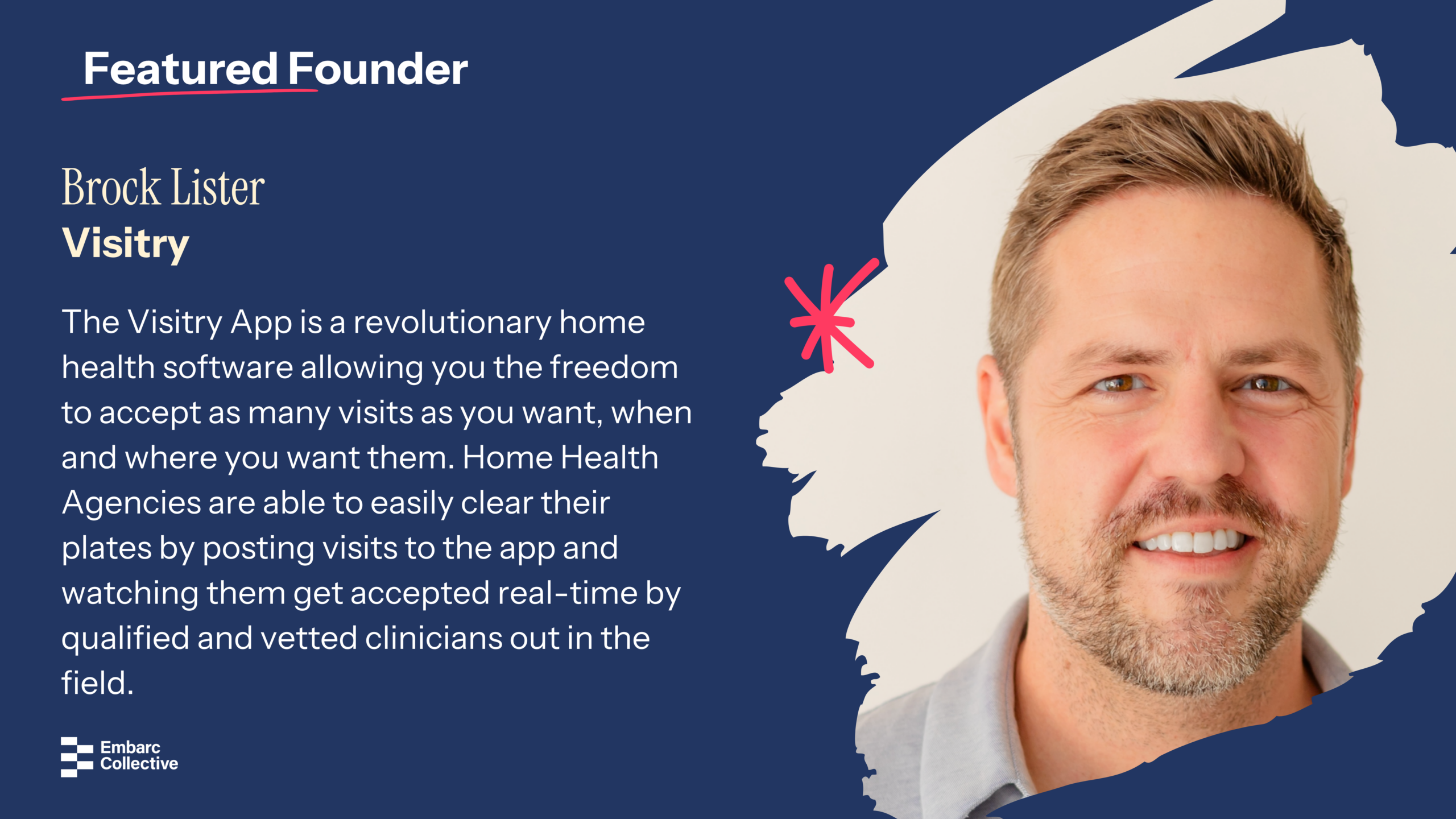
Welcome to our Featured Founder series, where you’ll meet startup founders from Tampa-St. Petersburg, who are building and scaling their ventures to solve some of the world’s greatest challenges. We interviewed Brock Lister of Visitry, which is a Home Health marketplace for agencies and clinicians.
What were you doing previously, and what inspired you to launch your company?
I was a physical therapist and still am, really. I graduated with well into six figures of student debt and quickly realized the traditional PT job market wasn’t going to get me there. I found home health and discovered something unexpected: it was actually a better way to practice. One-on-one care, real autonomy, patients who genuinely needed help. But it was buried under administrative chaos like scheduling nightmares, documentation overload, and fragmented agency coordination. I started building tools to fix that for myself, then for the other clinicians I was bringing into my network. At some point, I looked up and realized I wasn’t just solving my own problem anymore.
What pain point is your company solving? What gets you excited to go to work every day?
Clinicians, particularly PTs and OTs, are some of the hardest-working, most skilled people in healthcare. And the system consistently undervalues them. They’re underpaid, overloaded with admin work, and treated as interchangeable. What gets me up every day is the belief that when you fix that, when you actually support clinicians the way they deserve, patients receive better care as a direct result. It’s not complicated. It’s just never been the priority. We’re making it the priority.
Name the biggest challenge you faced in the process of launching the company. How did you overcome it?
Trust. Clinicians have been burned by staffing agencies so many times that the default assumption is skepticism and, for the most part, they’ve earned that skepticism. The way we’ve overcome it is by not trying to talk our way past it. We’re a company run by clinicians, myself, our Director of Clinical Operations, our Head of Operations, all of us have done the job. We don’t have to convince anyone we understand the problem. We have lived the problem. That credibility is something competitors can’t manufacture, and it’s what every relationship we’ve built has been founded on.
Where do you see your company headed next?
We’re deep in building out our V2 platform which is essentially a full operating system for a home health clinician. The goal is to remove every piece of administrative friction so clinicians can focus entirely on patient care. Long term, we want to own the Florida market before we expand, depth before breadth. The model has to be right before it scales. But the vision is clear: the most clinician-friendly therapy network in the country. We’re building toward that one county at a time.
Give us a tactical piece of advice that you’d share with another founder just starting out.
I had no business building software. But that turned out to be the point. I wasn’t building for engineers, I was building for clinicians who just want to do their job. Technology is only as good as the burden it removes. That’s the only metric I’ve ever cared about.
Why Florida?
Happy accident. My wife is from Tampa, and I’m from Buffalo; she won that argument. Best thing that ever happened to me professionally. Tampa has this rare combination of genuine community and serious momentum. It’s the kind of city that rewards people who show up early and build something real. I feel very lucky to be here for it.