Back to All Posts
Learn about upcoming events and the latest startup news—delivered to your inbox weekly.
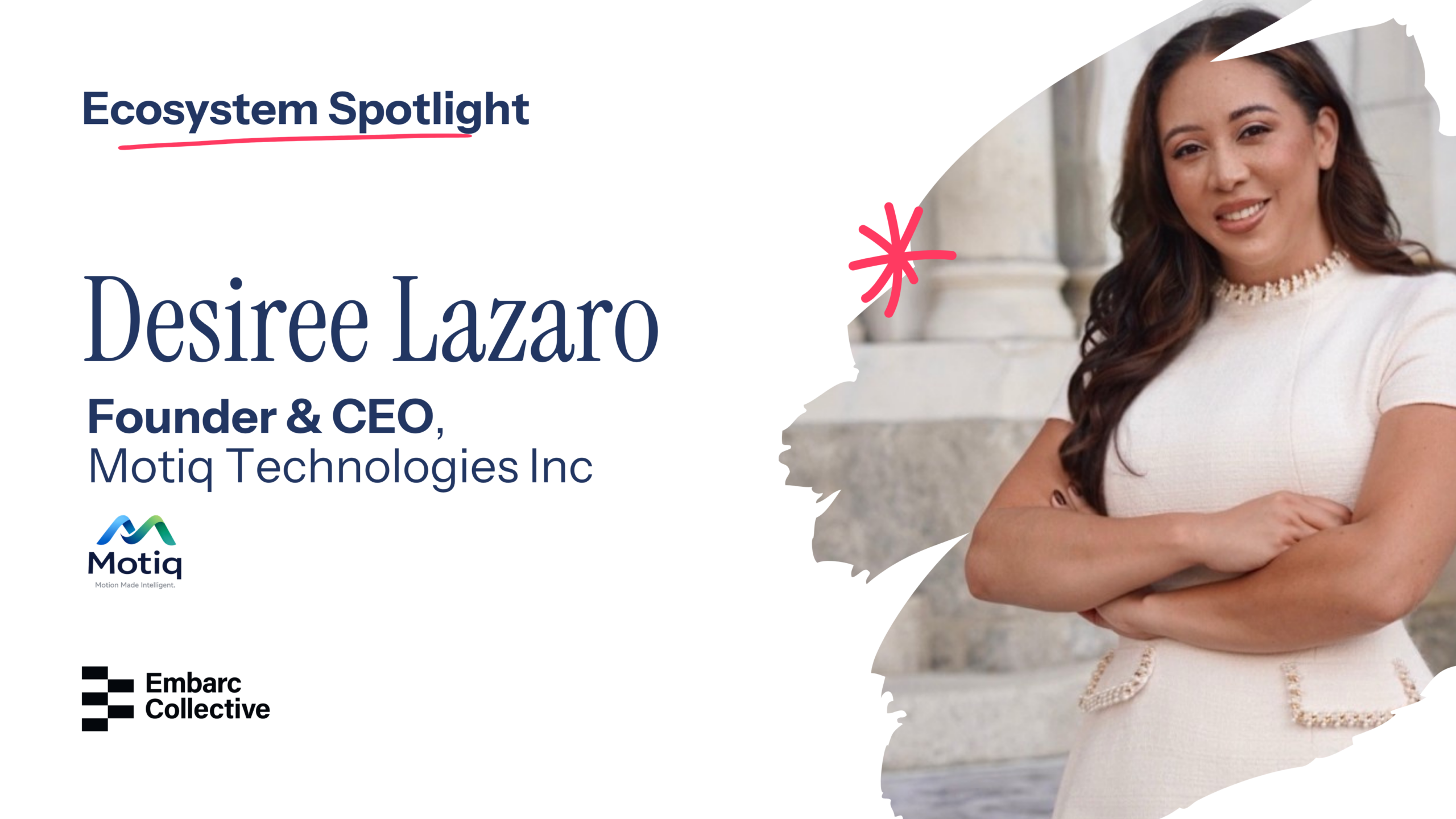
Welcome to our Ecosystem Highlight series, where you’ll meet the innovators in our vast ecosystem of startup builders in Florida, who are actively solving some of the world’s greatest challenges. We interviewed Desiree Lazaro, Founder & CEO of Motiq Technologies Inc, an AI-powered care coordination infrastructure for hospitals and care coordination teams, reducing care gaps and streamlining handoffs for high-acuity patients.
What were you doing previously, and what inspired you to join, launch, or help grow your company?
My career began in college at a Fortune 100 insurance company, where I spent over five years moving across property, auto, commercial, and casualty claims. My final role involved liability and fraud investigations, payment authorizations, and managing a full claims inventory — work that taught me how to read complex policy language and navigate high-stakes disputes.
From there, I moved to the country’s largest personal injury firm as an injury case manager, handling the other side of the equation. I managed pre-suit settlement negotiations up to seven figures under a managing partner, then coordinated the full hierarchy of post-settlement bill resolution — hospital liens, insurance coverages, and trust account disbursements — to get clients paid accurately and on time.
I then joined a NIH-funded research program housed at USF as a program manager for a multi-million dollar, multi-institutional federal grant focused on implementing AI in clinical settings. The work centered on reducing diagnostic gaps and improving accessibility — particularly post-COVID — by building data infrastructure and bridging silos across healthcare, academia, policy, and technology.
After that, I co-founded a tech-enabled medical transportation company operating in the gaps of care coordination. Running that company surfaced a recurring problem: a tool that I, my team, and the broader care ecosystem needed simply didn’t exist. That gap became Motiq.
Underlying all of it is something personal. I was a pediatric cancer patient who experienced these barriers to care firsthand — barriers that are compounded for those of certain socioeconomic backgrounds, as I was growing up. Since being deemed clinically cured, it has been my mission to transform that experience into something that opens doors for others. That’s why I’m building Motiq.
What pain point is your company solving? What gets you excited to go to work every day?
Healthcare is full of things we cannot control — but care coordination gaps are not among them. When the length or quality of someone’s life is reduced due to preventable failures in communication, follow-through, or handoffs, that is a solvable problem. That’s the pain point Motiq is built to address.
What gets me excited every day is deeply personal. I’m not building from the outside looking in — I’m a pediatric cancer survivor who experienced these gaps firsthand. I carry a quiet, reasonable awareness that illness could find me again, as it can any of us. Aging, disease, and health crises are universal. That shared vulnerability means I’m in this fight alongside everyone I serve, not above it.
There’s something clarifying about that. When the problem is personal and the market is every human being, the motivation doesn’t waver. I show up every day because this work matters to me as a founder, as a patient, and as someone who believes that what we can control in healthcare, we have a responsibility to get right.
What’s the biggest challenge you’ve faced in helping build or scale the company? How did you overcome it?
The biggest challenge has been credibility in a heavily gatekept industry where trust is earned slowly and credentials are the default currency. I’m not a physician or a PhD. In rooms full of clinicians, researchers, and institutional leaders, that gap is sometimes felt — and I’ve had to work harder to be taken seriously.
What I’ve come to understand, though, is that the very indoctrination that grants people those credentials can also build the blinders that sustain the silos I’m trying to solve. Too much institutional tenure can make it harder to see the system clearly. I came in without those blinders, and that turned out to be an asset.
I overcame the challenge the only way that works long-term: consistently showing up with integrity, doing the work, and positioning myself as a collaborator rather than a competitor. I’m not here to devalue expertise — I’m here to connect it. The clinicians, researchers, and operators I work with bring depth I don’t have, and I bring a cross-industry perspective and a willingness to challenge assumptions that they often can’t afford to voice from inside their institutions.
Over time, that consistency speaks for itself. The doubt doesn’t disappear, but it becomes less relevant as the work accumulates. I’ve learned to let the work answer the question of why me.
Where do you see your company headed next?
The immediate focus is closing a hybrid pre-seed funding round, which will allow us to complete feasibility studies alongside trusted industry co-developers. From there, we’ll pilot the first version of the product, validate the model, and convert that validation into initial customers and revenue.
That first paying customer cohort becomes the foundation — proof we can point to as we expand our partner network, deepen trust in the market, and feed a continuous improvement loop where every new relationship and use case makes the product stronger.
The trajectory is deliberate: valid
Give us a tactical piece of advice that you’d share with someone building or growing a company.
Do your customer discovery before you do anything else. Talk to the people you think you’re building for — not to validate your idea, but to genuinely understand their problem. I recommend The Mom Test by Rob Fitzpatrick as a practical guide for having those conversations honestly, and programs like NSF I-Corps if you want a structured framework for doing it at depth. I went through I-Corps before building, and it changed how I understood my customer entirely.
The second thing I’d tell every founder is to protect what you build from day one. File your provisional patent early. Think about your IP strategy — whether that’s patents, copyright, or trade secret protection — before you’re in rooms pitching or collaborating, not after. Most founders think about protection too late, after they’ve already been exposed. Security and IP aren’t legal formalities you deal with eventually; they’re strategic assets you establish at the beginning.
Why Florida?
Florida is an underrated place to build, and I think that’s changing fast. Beyond the quality of life — it’s a genuinely wonderful place to raise a family and live year-round — the business environment is strong. No state income tax, meaningful state-level support for startups and businesses, and a growing ecosystem that wants to see founders succeed.
What I value most, though, is the signal-to-noise ratio. You’re not competing for attention against thousands of better-funded companies the way you would in New York or Silicon Valley. Here, it’s possible to build real traction, get noticed, and develop meaningful relationships without being drowned out. The ecosystem is large enough to matter and accessible enough to move in. For a founder at the early stages, that combination is hard to beat.