Back to All Posts
Learn about upcoming events and the latest startup news—delivered to your inbox weekly.
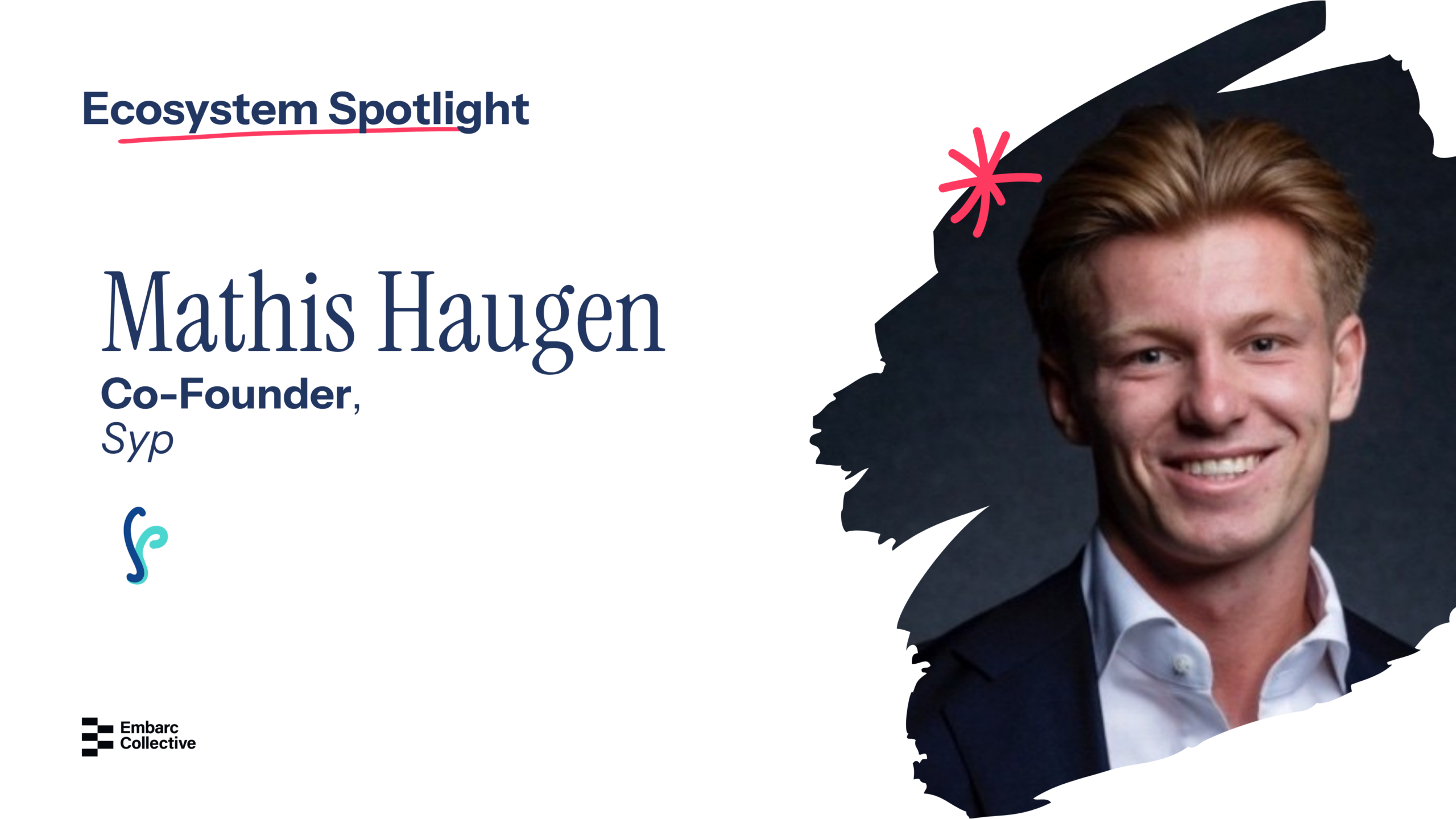
Welcome to our Ecosystem Highlight series, where you’ll meet the innovators in our vast ecosystem of startup builders from across Florida, who are actively solving some of the world’s greatest challenges. We interviewed Mathis Haugen, Co-Founder of syp, which turns any water bottle into a smart hydration platform.
What were you doing previously, and what inspired you to join, launch, or help grow your company?
Before launching syp, I was a freshman Division I athlete at the University of South Florida, living the same routine as every other athlete on my roster — training, competing, recovering, repeating. That changed when I suffered a season-ending injury that traced back, over time, to chronic dehydration. It was not a single bad day. It was months of small deficits no one could see, no one was tracking, and no one had the tools to catch. Sitting on the sideline, I realized that across all of collegiate athletics — programs with eight-figure budgets and elite training staff — no one had a real way to know if athletes were actually hydrating. Coaches were guessing. Athletes were self-reporting. And the consequences were landing on bodies like mine. I started syp because the gap between what we measure in athletics and what actually breaks athletes down is too large, and hydration was the most obvious place to start closing it.
What pain point is your company solving? What gets you excited to go to work every day?
syp is solving the invisible hydration gap in high-performance environments. Coaches, trainers, and the people responsible for athlete health have no objective, real-time way to know if their athletes are actually hydrating — and the cost of that blind spot shows up as cramps, injuries, slower recovery, and underperformance. We replace guesswork with ground truth. What gets me out of bed every day is knowing that hydration is just the first chapter. The same technology, the same data, and the same platform we are building for D1 athletics has obvious applications across professional sports, military performance, healthcare, elderly care, and industrial workforces — anywhere dehydration quietly compounds into real harm. I am not just excited to help athletes perform better. I am excited because syp can help people live safer, healthier, and more optimized lives across every environment where hydration matters and no one is watching.
What’s the biggest challenge you’ve faced in helping build or scale the company? How did you overcome it?
Our biggest challenge came at the moment we needed to go from a 3D-printed concept to a real, functional prototype. We had earned a spot in a USF accelerator — one of seven teams selected from 120 applicants — with a promise of $50K in non-dilutive funding waiting at the end. Then we were removed from the program because both founders were international. Overnight, we went from a clear path forward to zero capital, no funding mechanism, and no way to bring the product to market. We needed $25K within 30 days to start product development — pre-revenue, pre-product, with nothing to show but conviction. So we stopped waiting for institutional money and started telling the story directly to people who understood the problem. In that month, we raised $35K from a NCAA coach who saw the athletic application immediately and an agricultural industry expert who recognized the parallel use case in industrial labor. That moment taught us something we have leaned on ever since: when the system says no, the right people say yes — if you can find them and tell the story honestly.
Where do you see your company headed next?
The next chapter for syp is proving the model in collegiate athletics. Five Division I programs are committed to our Fall 2026 pilot, and that pilot is where we turn a good idea into a category. But athletics is the entry point, not the destination. The product we are building — a universal sensor that captures real hydration data without asking anyone to change behavior — has obvious applications in any environment where dehydration quietly compounds into harm. Professional sports. Military performance. Healthcare. Elderly care. Industrial labor. The pattern is the same everywhere: people responsible for human performance and safety are making decisions blind, and we have the technology to give them sight. Long term, syp is not a hardware company. We are building the data layer for human hydration — the dataset, the AI models, and the API infrastructure that powers everything from insurance partnerships to clinical research to occupational health programs. Hydration is one of the few biological signals that touches every population on earth. We intend to be the company that finally measures it well.
Give us a tactical piece of advice that you’d share with a founder just starting out.
Build with co-founders and partners you trust deeply, but also genuinely enjoy working with. The relationship matters more than the resume. You will spend more time with these people than with anyone else in your life, and you will face moments where the only path forward is a hard, honest conversation — about money, about direction, about someone not pulling their weight, about a decision one of you is wrong about. If the foundation of the relationship is not strong enough to absorb those conversations without breaking, the company will not survive them. Pick people whose minds you respect, whose values you share, and whose company you actually want to keep on the worst days. Skills can be hired. Trust cannot.
Why Florida?
Two reasons — one practical, one strategic. Practically, Florida is the perfect proving ground for a hydration company. The heat, humidity, and year-round training demand mean dehydration is not a seasonal concern here — it is a daily one. Athletes in Florida sweat more, lose more, and feel the consequences faster than almost anywhere else in the country. If syp works here, it works everywhere. Strategically, the Tampa Bay ecosystem has been one of the strongest accelerants we could have asked for. The density of operators, capital, and university resources — between USF, Embarc Collective, Tampa Bay Wave, and the broader founder community — means a young company can find serious mentors, investors, and partners without leaving the region. Florida has the climate that validates our product and the ecosystem that builds the company around it. Both matter. We are not in Florida by accident.
Join the Community
Interested in joining a community of founders, builders, innovators, and startup teams while gaining access to member-exclusive events, programming, coaching, and resources throughout the year?
Explore membership and learn more about becoming part of Embarc Collective.