Back to All Posts
Learn about upcoming events and the latest startup news—delivered to your inbox weekly.
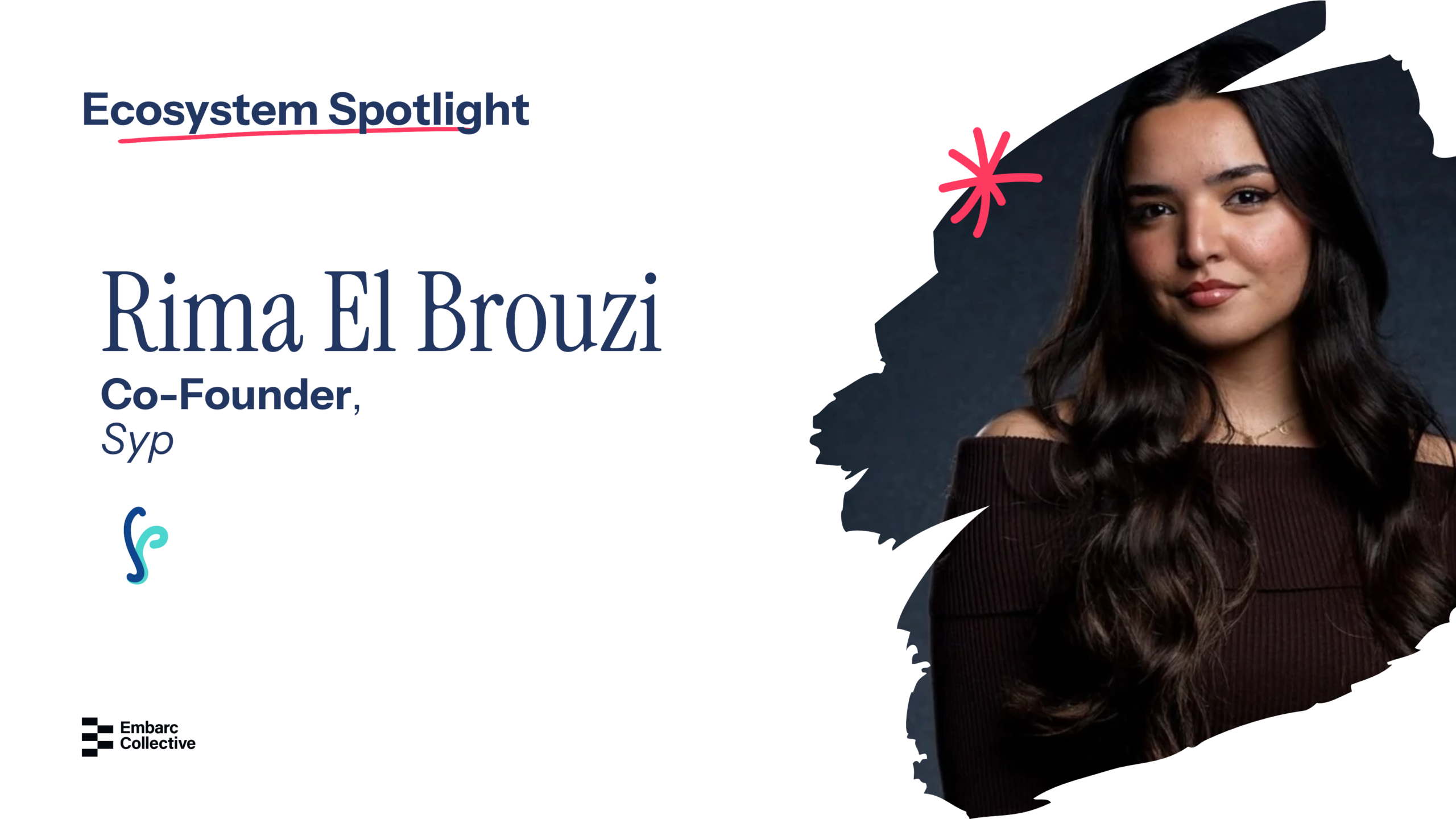
Welcome to our Ecosystem Highlight series, where you’ll meet the innovators in our vast ecosystem of startup builders from across Florida, who are actively solving some of the world’s greatest challenges. We interviewed Rima El Brouzi, Co-Founder of syp, which turns any water bottle into a smart hydration platform.
What were you doing previously, and what inspired you to join, launch, or help grow your company?
I came to the U.S. from Morocco at 17 to study computer science at the University of South Florida. At USF, I ended up spending nearly five years working inside Division I athletics while also doing research in AI and human reasoning. I had grown up as a competitive swimmer, so sports, technology, and human performance were already three worlds I cared deeply about.
syp started at the intersection of those worlds. My co-founder Mathis brought the problem from his experience as an athlete, and I immediately saw the technical challenge behind it: how do you measure something as simple and universal as drinking water without asking people to log every sip, change bottles, or think about it at all?
What has kept me committed is bigger than hydration itself. I love building things that make people’s lives better, and syp allowed me to take something from an idea on a whiteboard to technology that can eventually affect how people understand and manage their health and performance.
What pain point is your company solving? What gets you excited to go to work every day?
We have incredible amounts of data in sports now: sleep, heart rate, workload, recovery, GPS, but one of the most basic inputs into human performance is still largely based on athletes remembering what they drank or someone watching water bottles from the sideline.
syp is designed to make hydration intake measurable without adding another task to someone’s day. Our device attaches to the bottle people already use, while the software turns that intake into information athletes and performance staff can actually act on.
What excites me most is building the intelligence behind that data. Once you can reliably understand what someone is consuming, you can start connecting it to workload, environment, recovery, and eventually other physiological signals to understand what that individual actually needs.
That is the part I find fascinating: taking something that currently feels invisible and turning it into useful information. Athletics is an incredible environment to build and validate that technology, but the underlying problem exists far beyond sports.
What’s the biggest challenge you’ve faced in helping build or scale the company? How did you overcome it?
One of our biggest challenges has been learning that building something that works and building something that is ready for the real world are two very different things.
Coming from a computer science background, I was used to problems where you could write code, test it, identify what was wrong, and iterate until you had a solution. Hardware introduces an entirely different level of complexity. Suddenly, you’re dealing with manufacturing constraints, physical materials, sensor accuracy, battery life, and dozens of variables that don’t always behave the way you expect.
And when you’re building something that people will rely on for meaningful decisions, getting it to work once isn’t enough. It has to work consistently.
We’ve had to rethink designs, challenge assumptions, bring in outside expertise, and make difficult decisions about where to invest our limited time and resources. The biggest shift was learning to treat setbacks as information rather than just obstacles.
It’s taught me to become a much more disciplined builder. You can be incredibly ambitious about where you’re going while being brutally realistic about what still needs to be proven.
Where do you see your company headed next?
The immediate goal is simple: get syp into athletes’ hands and prove that the technology creates measurable value for teams.
We have spent a lot of time building, testing, talking to athletes and performance staff, and learning what the product needs to become. The next phase is about translating that work into real-world deployment with collegiate athletic programs and using those environments to build the strongest possible dataset around hydration behavior.
Long term, I see the physical product as the beginning rather than the end. The really valuable layer is what becomes possible once you have continuous, reliable intake data: individualized recommendations, predictive models, integrations with other performance systems, and eventually applications well beyond athletics.
Our ambition is for syp to become infrastructure for understanding hydration, not just another device someone wears or an app someone has to remember to open.
Give us a tactical piece of advice that you’d share with a founder just starting out.
Don’t get too attached to the way you originally imagined your company would grow.
Some of the most important decisions we’ve made at syp came from realizing that what made sense six months ago wasn’t necessarily what made sense today. Your product will evolve, your customers will teach you things you didn’t anticipate, and opportunities will come from places you weren’t looking.
Have a clear vision of what you’re trying to accomplish, but stay flexible about how you get there. Talk to your customers constantly, question your own assumptions, and be willing to change direction when the evidence tells you to.
I think one of the most valuable skills a founder can develop is knowing the difference between being persistent and being stubborn. You should be relentless about the problem you’re solving, not necessarily the first solution you came up with.
Why Florida?
Florida is where I learned to build.
I moved here from Morocco at 17 without really knowing what my life in the U.S. would look like. USF became the place where I studied computer science, got involved in Division I athletics, entered research, met my co-founder, and eventually started syp.
Tampa Bay in particular gave us access to an ecosystem that is unusually willing to help early founders. Through USF, Embarc Collective, mentors, investors, coaches, athletes, and other founders, we have repeatedly found people willing to make an introduction, challenge an assumption, test something with us, or help us solve the next problem.
There is also something uniquely fitting about building a hydration company in Florida. Heat, humidity, athletics, outdoor work, and year-round activity make the problem extremely tangible here.
For me, though, Florida is more than a good market for syp. It is where I went from being a student who loved building things to actually becoming a founder. A lot of people here gave me a chance before I had a track record, and I want syp to become one of the companies that proves what can be built from this ecosystem.
Join the Community
Interested in joining a community of founders, builders, innovators, and startup teams while gaining access to member-exclusive events, programming, coaching, and resources throughout the year?
Explore membership and learn more about becoming part of Embarc Collective.