Back to All Posts
Learn about upcoming events and the latest startup news—delivered to your inbox weekly.
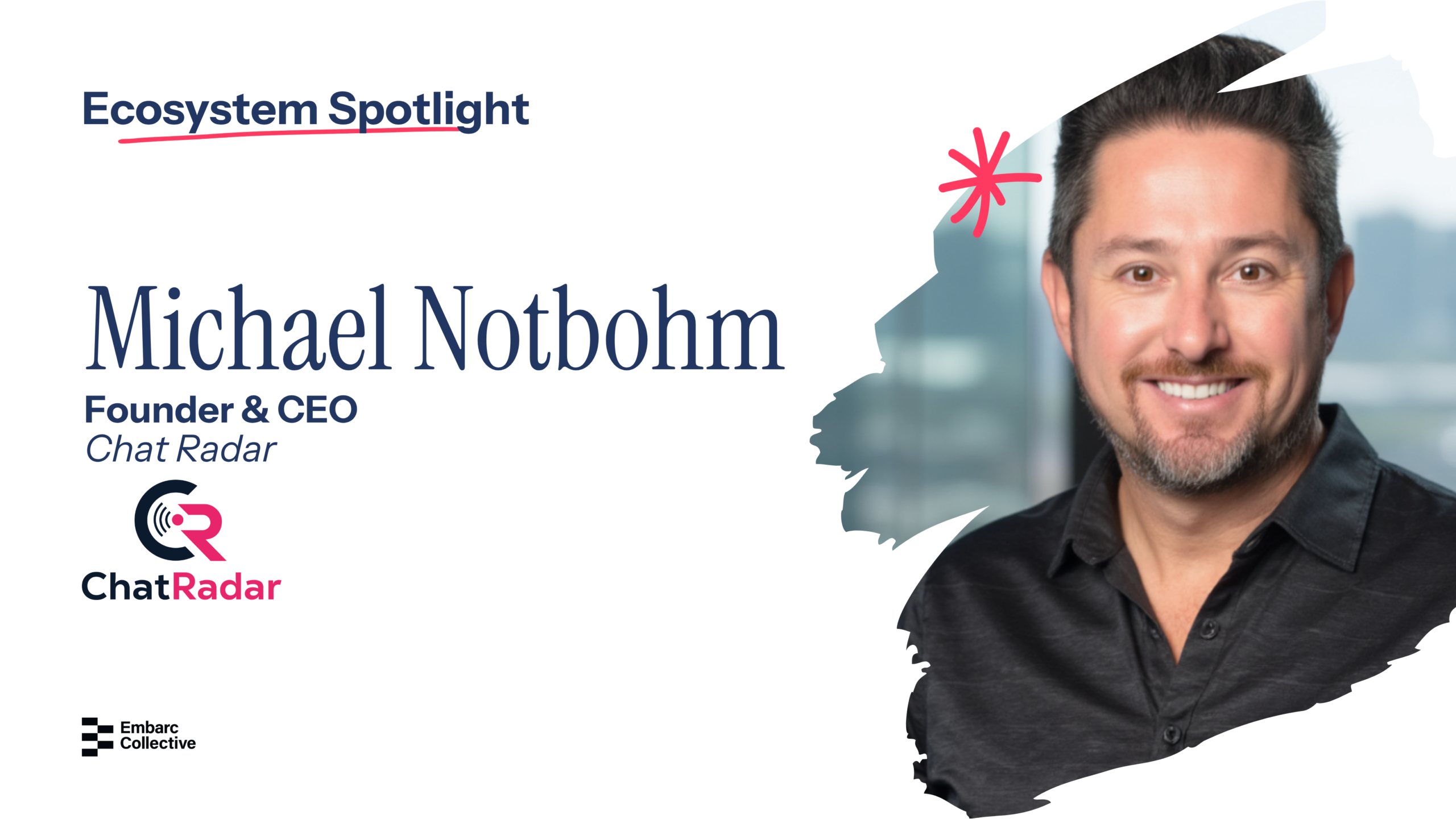
Welcome to our Ecosystem Highlight series, where you’ll meet the innovators in our vast ecosystem of startup builders from across Florida who are actively solving some of the world’s greatest challenges. We interviewed Michael Notbohm, Founder & CEO of Chat Radar, which delivers AI search analysis, strategy, and optimization so local businesses and multi-location brands get found and recommended in ChatGPT, Gemini, Perplexity, and Google AI.
What were you doing previously, and what inspired you to join, launch, or help grow your company?
Before Chat Radar, I spent 12 years in MarTech, including at Yellowpages.com and LexisNexis, running my own web design firm, and helping with the launch of Clarky AI. In between, I spent nearly a decade in dental implant sales at BioHorizons, which put me in front of hundreds of local practices and gave me a real feel for how small businesses actually win customers.
Most recently, I was running LeadsGenie.ai, an agency helping local businesses with AEO/GEO. That’s where the idea came from. Our clients were still obsessing over Google rankings while their customers were asking ChatGPT, Gemini, and Perplexity “who’s the best dentist near me,” and nobody could tell them whether they showed up in those answers, let alone how to fix it. The tools that existed were built for enterprise brands, not a dealership or a dental practice.
I started building Chat Radar in February 2026 to give local and multi-location businesses visibility: analysis of how AI engines see them, a strategy to close the gaps, and the optimization and content to get them cited and recommended. We launched the MVP in April and now serve clients across automotive, dental, home services, and more
What pain point is your company solving? What gets you excited to go to work every day?
Local businesses are losing customers they never knew they had. People now ask ChatGPT, Gemini, Perplexity, and Google AI, “Who should I go to for this near me?” and the AI gives one or two names. If you’re not one of them, you don’t lose a click; you lose the whole decision. Most owners have no idea whether they show up in those answers, why a competitor does, or what to do about it, and the tools that exist are built and priced for enterprise brands. Chat Radar closes that gap: it shows a business exactly how AI engines see it, where it’s being skipped, and then does the strategy and optimization work to get it cited and recommended.
What gets me excited: Watching a business go from invisible to being the answer. On nearly every client call, there’s a moment where I show an owner a prompt their customers are actually asking, and the AI recommends them by name for the first time. You can see it land. I also love that we’re early. The rules of AI search are still being written, and every week we learn something about how these engines choose their sources that nobody else has figured out yet. Turning that into real wins for local businesses is the best part of the job.
What’s the biggest challenge you’ve faced in helping build or scale the company? How did you overcome it?
The biggest challenge was a forced rebrand a few months after launch. We started as Askable on askable.dev, and a trademark dispute meant we had to give up the name and the domain on a hard deadline. By then, the entire product was tied to it: customer logins, authentication, email, client blog hosting on custom domains, Google OAuth, search rankings, and every proposal and report that had ever gone out with the old name on it. For a one-person company with paying customers depending on the platform every day, it felt like changing the engine while the car was moving.
I overcame it by treating it as a project instead of a crisis. I picked the new name, Chat Radar, quickly and committed to it rather than agonizing. Then I mapped every dependency on the old domain, sequenced the cutover so nothing customer-facing broke, moved authentication and email first, set up redirects so search equity carried over, and ran Google’s change-of-address and OAuth re-verification ahead of the deadline. Clients saw a new logo and a new URL and nothing else.
What I took from it is that a brand is less fragile than it feels. The product, the results, and the relationships are what customers actually bought, and all three came through intact. Chat Radar is also a better name than the one we lost.
Where do you see your company headed next?
Three things are next. First, scale what’s working. We’ve proven the model with managed clients across several industries, and the next step is building a small sales and client-success team so growth isn’t limited by my own calendar. Second, go deeper into verticals. We’re launching industry-specific versions of the platform under their own brands, with the first already underway through a partnership in the dental space, and that playbook will repeat in other industries where owners want a solution that speaks their language. Third, move upmarket to multi-location and franchise brands, where one decision covers dozens of locations and the visibility problem is multiplied.
Underneath all of that, the product keeps getting smarter. Every scan we run teaches us more about how AI engines choose who to recommend, and that data is becoming a real asset: we’re already publishing a weekly index of local AI search trends, and I expect that intelligence layer to become as valuable as the service itself.
I’m weighing a first round of outside capital to accelerate the team, and I’d like Chat Radar to be the name local businesses think of when they ask, “How do I show up in AI search?” Being part of Embarc Collective is about getting there faster, with people in Tampa who’ve done it before.
Give us a tactical piece of advice that you’d share with a founder just starting out.
Sell it before you finish building it. I started Chat Radar in February and had paying customers by April, and the MVP those first customers used was embarrassing compared to what it is now. That was the point. Every feature we’ve built since came from a real client saying “this is great, but what I actually need is…” rather than from me guessing in a room by myself.
The tactical version: pick one narrow customer, get in front of ten of them, and show them the real problem with their own data before you show them your product. For us, that meant running a free scan on a prospect’s business and showing them the exact AI answers where a competitor was recommended, but they weren’t. Nobody argues with their own numbers. Once they feel the pain, the sale is about trust, not features, and the product gets to grow up with the customers already on it.
The same scan that closes deals is also the cheapest market research you’ll ever do. Build your demo so it doubles as a diagnostic, and you’ll learn more in a month of calls than in six months of building.
Why Florida?
I’m here by choice, not by default. Years ago I moved to Las Vegas convinced the grass was greener somewhere else, and it didn’t take long to learn it wasn’t. What I’d been taking for granted in Tampa Bay was exactly what I ended up missing: family close by, a community I actually know, and a place that feels like home instead of a place to pass through. I came back twelve years ago, and I haven’t questioned it since.
Tampa is where my life is. My daughter is a senior at Plant High School, my family is here, and I have a two-year-old son I’m looking forward to raising in the Florida sunshine. I want to build a company in the same place I’m building a life, with people who’ll see the whole story.
It also happens to be the right place to build a tech company right now. Tampa has the talent, the cost of living, the business climate, and the energy of a city that’s still deciding what it wants to be, and I think it can be a real destination for technology companies, not just a place founders leave from. I’d rather help prove that than go chase it somewhere else. Embarc is a big part of why that’s possible here, and I want Chat Radar to be one of the companies that makes the case.
Join the Community
Interested in joining a community of founders, builders, innovators, and startup teams while gaining access to member-exclusive events, programming, coaching, and resources throughout the year?
Explore membership and learn more about becoming part of Embarc Collective.