Back to All Posts
Learn about upcoming events and the latest startup news—delivered to your inbox weekly.
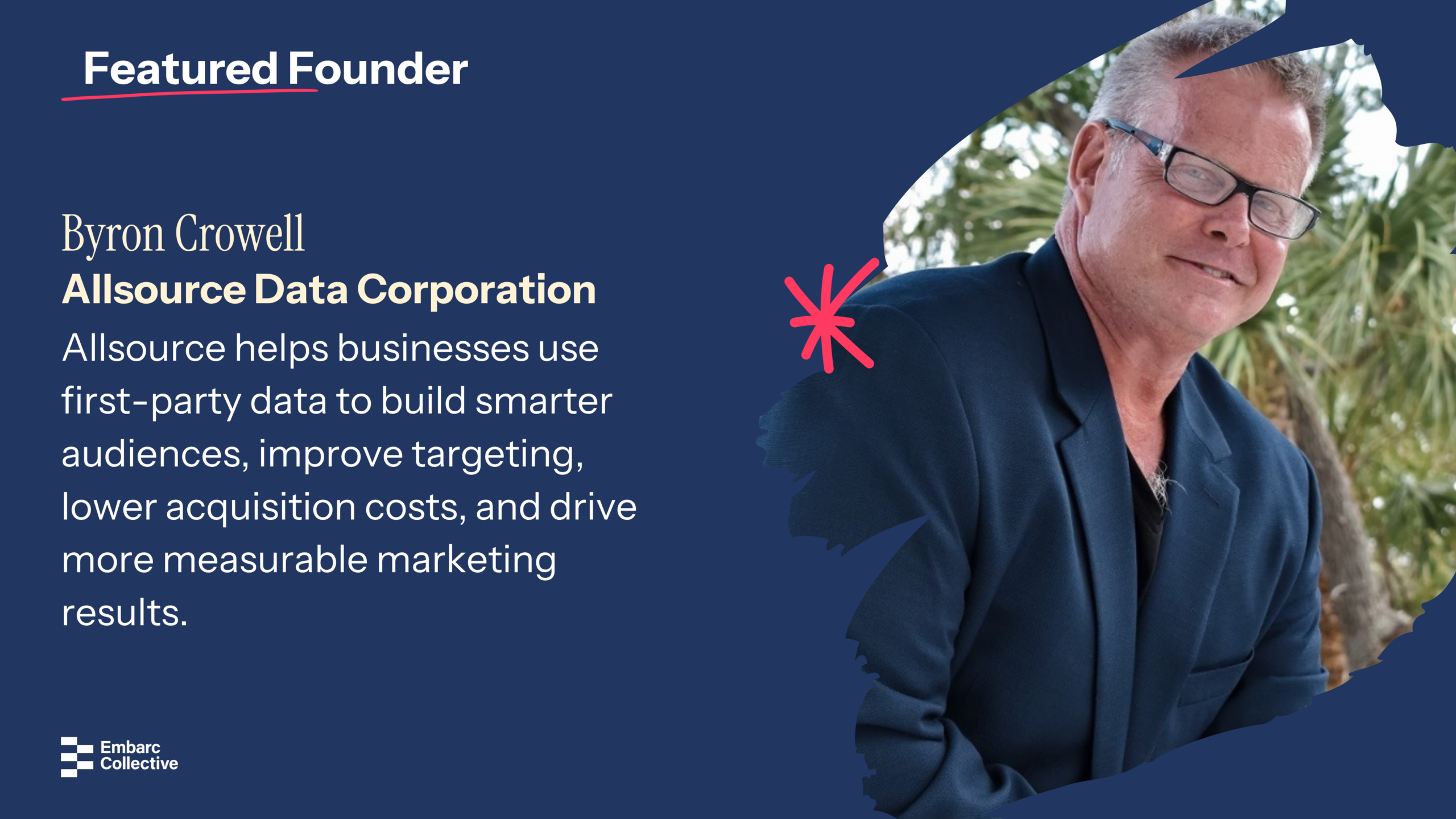
Welcome to our Featured Founder series, where you’ll meet startup founders from Tampa-St. Petersburg, who are building and scaling their ventures to solve some of the world’s greatest challenges. We interviewed Byron Crowell, Founder & CEO of Allsource Data Corporation, which helps businesses use first-party data to build smarter audiences, improve targeting, lower acquisition costs, and drive more measurable marketing results.
What were you doing previously, and what inspired you to launch your company?
Before launching Allsource, I spent more than 25 years building data infrastructure, identity graphs, enrichment systems, and audience products across several ventures. That work included helping large organizations use data more intelligently for sales and marketing, and it gave me a front-row seat to how difficult it still is for most businesses to turn raw customer data into something actionable. Even companies spending heavily on digital marketing were often flying blind, relying on rented audiences, incomplete attribution, and platforms that controlled both reach and results.
What inspired me to launch Allsource was seeing the same problem repeat over and over: businesses were sitting on valuable first-party data, but they lacked the tools to use it to consistently improve performance. Through our earlier Smart Audience work, we saw that a company’s own customer outcomes were often the strongest predictor of who their next best customer would be. That insight became the foundation for Allsource.
I launched the company to productize that capability—to give agencies and growth-focused businesses a practical platform that helps them match, enrich, analyze, and activate their own data without needing a team of data scientists. The goal is to help customers own their audiences, reduce wasted spend, and create repeatable lift in sales and marketing.
What pain point is your company solving? What gets you excited to go to work every day?
Allsource is solving a major problem in modern marketing: businesses are spending more and more to acquire customers, but they still do not truly know who their best prospects are. Most companies rely on ad platforms, static third-party lists, or surface-level analytics that tell them what happened, but not who is most likely to convert next. That leads to wasted spend, weak targeting, and too much dependence on platforms that control access, pricing, and performance.
We built Allsource to change that. Our platform helps companies use their own first-party outcomes—such as customers, leads, website visitors, and churned users—to identify the attributes that actually predict conversion. From there, they can build and activate smarter audiences across channels, suppress poor-fit targets, and make marketing more efficient and repeatable.
What excites me every day is that this is a real, costly problem for thousands of businesses, and we know there is a better way to solve it. I like building something practical that gives companies more control over their growth instead of forcing them to rent access from walled gardens. It is especially energizing to help agencies and operators use sophisticated data capabilities that were once only available to large enterprises with massive technical teams.
Name the biggest challenge you faced in the process of launching the company. How did you overcome it?
One of the biggest challenges in launching Allsource was turning a high-touch, expert-driven service into a scalable software platform. We knew the underlying approach worked because we had already helped clients improve targeting and reduce wasted spend through Smart Audience work, but packaging that process into software was a very different challenge. It meant translating complex data matching, enrichment, modeling, and activation workflows into something reliable, intuitive, and usable by non-technical operators.
A second challenge was building the company while also challenging the status quo of digital marketing. Many businesses are used to renting audiences and depending on walled-garden platforms, so part of the launch process was not just building technology, but also helping the market understand why using first-party outcomes as the foundation for targeting is more powerful and sustainable.
We overcame those challenges by staying close to real customer use cases, building from actual service experience rather than theory, and focusing on practical outcomes instead of hype. We used what we learned from earlier engagements to shape the product, prioritize the right workflows, and keep the platform grounded in measurable value. That discipline helped us move from a custom service model toward a repeatable platform with a clear purpose.
Where do you see your company headed next?
We’re extending our enrichment data types to service political and international use cases.
Give us a tactical piece of advice that you’d share with another founder just starting out.
Build with co-founders and partners you trust deeply, but also genuinely enjoy working with. The relationship matters more than the resume. You will spend more time with these people than with anyone else in your life, and you will face moments where the only path forward is a hard, honest conversation — about money, about direction, about someone not pulling their weight, about a decision one of you is wrong about. If the foundation of the relationship is not strong enough to absorb those conversations without breaking, the company will not survive them. Pick people whose minds you respect, whose values you share, and whose company you actually want to keep on the worst days. Skills can be hired. Trust cannot.
Why Florida?
Two reasons — one practical, one strategic. Practically, Florida is the perfect proving ground for a hydration company. The heat, humidity, and year-round training demand mean dehydration is not a seasonal concern here — it is a daily one. Athletes in Florida sweat more, lose more, and feel the consequences faster than almost anywhere else in the country. If syp works here, it works everywhere. Strategically, the Tampa Bay ecosystem has been one of the strongest accelerants we could have asked for. The density of operators, capital, and university resources — between USF, Embarc Collective, Tampa Bay Wave, and the broader founder community — means a young company can find serious mentors, investors, and partners without leaving the region. Florida has the climate that validates our product and the ecosystem that builds the company around it. Both matter. We are not in Florida by accident.