Back to All Posts
Learn about upcoming events and the latest startup news—delivered to your inbox weekly.
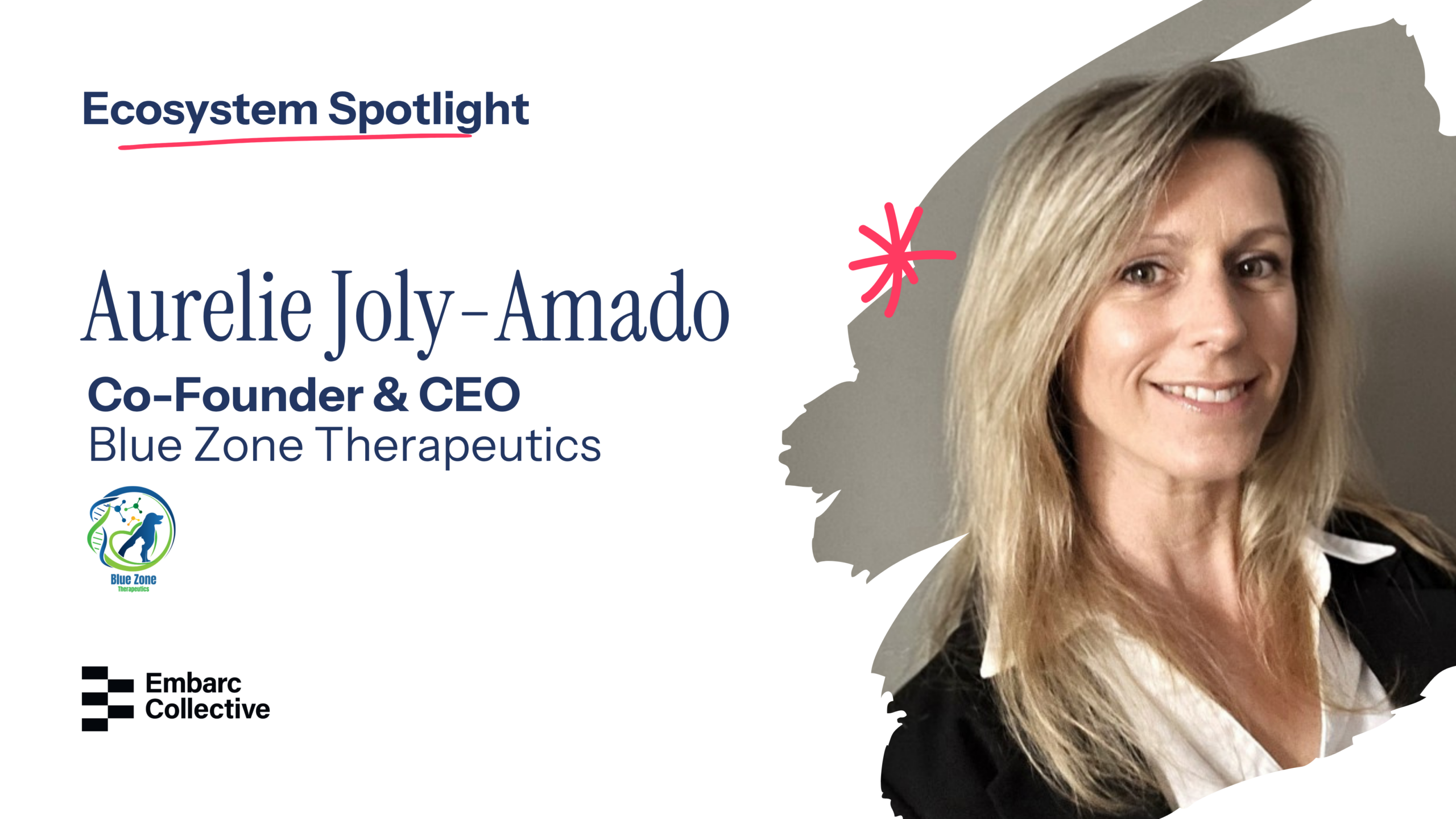
Welcome to our Ecosystem Highlight series, where you’ll meet the innovators in our vast ecosystem of startup builders from Tampa-St. Petersburg, who are actively solving some of the world’s greatest challenges. We interviewed Aurelie Joly-Amado, Co-Founder & CEO at Blue Zone Therapeutics, a company that is committed to developing innovative, effective, and practical treatments that target age-related diseases in pets, so they too can enjoy longer, healthier lives.
What were you doing previously, and what inspired you to join, launch, or help grow your company?
I am an academic researcher in neurodegenerative diseases, with a focus on preclinical models of Alzheimer’s disease and translational therapeutics. Through this work, I developed a deep understanding of the gap between promising scientific discoveries and their progression into real-world treatments. At the same time, I became increasingly interested in the underexplored opportunity to innovate in veterinary medicine, particularly for age-related diseases that mirror human conditions.
The inspiration to launch Blue Zone Therapeutics came from recognizing both the scientific potential and the unmet need: companion animals suffer from many of the same chronic diseases as humans, yet therapeutic options remain limited. I saw an opportunity to bridge cutting-edge biomedical research with practical applications in veterinary health, accelerating innovation in a space that can benefit both animals and, potentially, human medicine through comparative insights.
What pain point is your company solving? What gets you excited to go to work every day?
BlueZone Therapeutics addresses the lack of effective treatments for age‑related diseases in companion animals, where current options are limited and often only manage symptoms. We’re bridging the gap between cutting‑edge biomedical research and real-world veterinary care.
What excites me every day is turning meaningful science into therapies that improve both lifespan and quality of life for pets, while also generating insights that could benefit human health.
What’s the biggest challenge you’ve faced in helping build or scale the company? How did you overcome it?
One of the biggest challenges is bridging the gap between academic research and building a viable commercial company, translating complex science into a clear product, regulatory path, and market strategy.
I am addressing this by actively engaging in entrepreneurial programs like NSF I‑Corps, the Embarc Collective, speaking with stakeholders across the veterinary and biotech sectors, and refining the value proposition based on real market needs. This process helps us turn an early scientific concept into a focused, scalable company strategy.
Where do you see your company headed next?
We’re actively pursuing non‑dilutive funding, particularly through programs like NIH and NSF SBIR/STTR, to advance our technology without giving up equity. These grants are critical for de‑risking our early-stage therapeutics, supporting key preclinical milestones, and validating our approach. Leveraging non‑dilutive funding allows us to build scientific and regulatory momentum while maintaining flexibility as we scale toward later-stage investment and commercialization.
Give us a tactical piece of advice that you’d share with someone building or growing a company.
Talk to customers early and often, even before your product is fully formed. It’s tempting to focus on perfecting the science or technology, but real traction comes from deeply understanding the problem, validating demand, and refining your value proposition based on direct feedback. This will save you time, help avoid costly missteps, and ensure you’re building something people actually need.
Why Florida?
Florida offers a unique combination of strong biomedical research, growing biotech infrastructure, and a supportive startup ecosystem. Proximity to major academic institutions and clinical partners makes it an ideal environment for translational work in veterinary and comparative medicine.
Additionally, Florida has a large and engaged pet population, along with access to non‑dilutive funding programs and state-level innovation support, making it a strategic place to build and scale BlueZone Therapeutics.