Back to All Posts
Learn about upcoming events and the latest startup news—delivered to your inbox weekly.
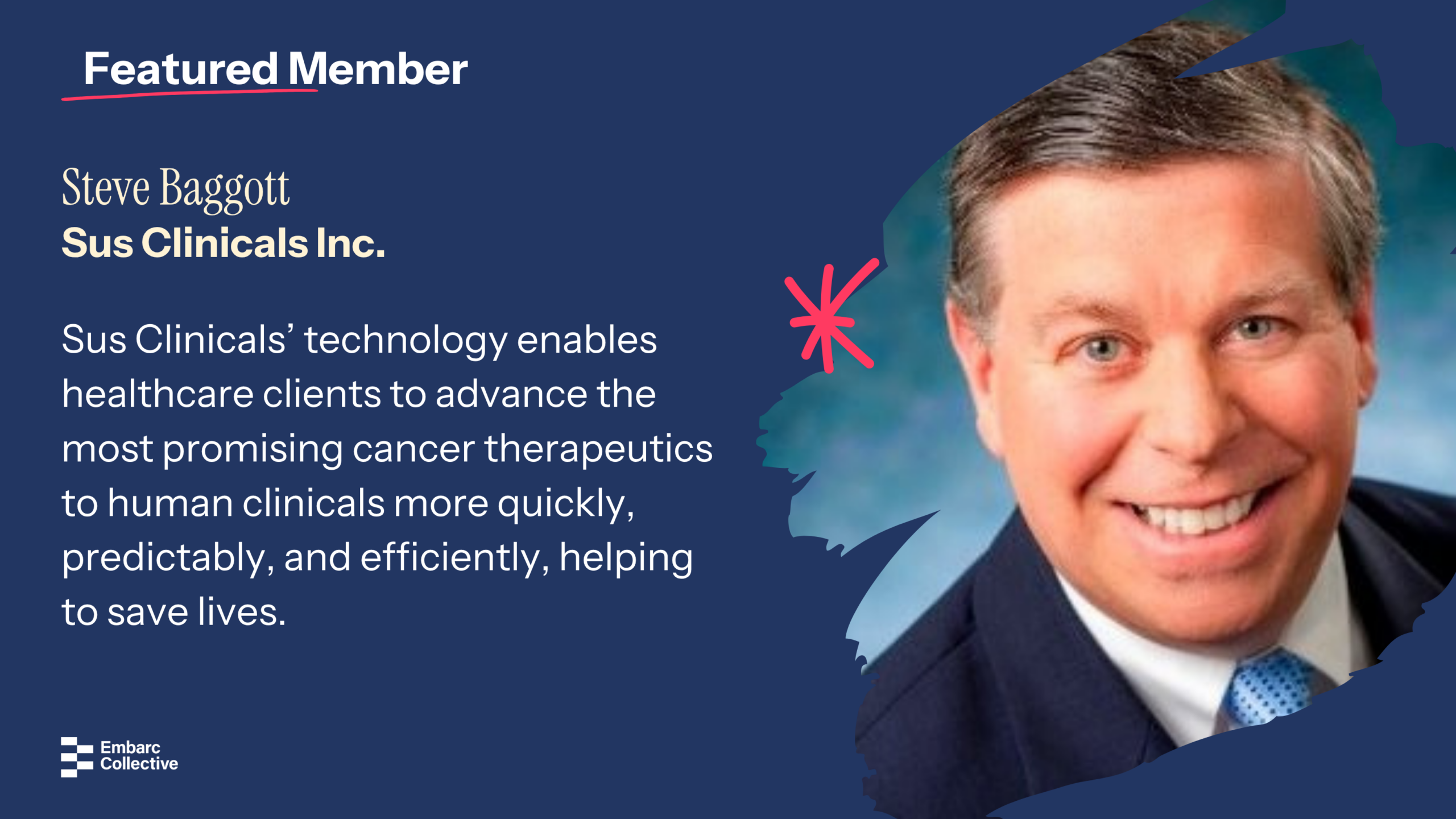
Welcome to our Featured Founder series, where you’ll meet startup founders from Tampa-St. Petersburg, who are building and scaling their ventures to solve some of the world’s greatest challenges. We interviewed Steve Baggott, COO at Sus Clinicals, which enables healthcare clients to advance the most promising cancer therapeutics to human clinicals more quickly, predictably, and efficiently, helping to save lives.
Please provide a brief one-liner about your company.
Sus Clinicals’ technology enables healthcare clients to advance the most promising cancer therapeutics to human clinicals more quickly, predictably, and efficiently, helping to save lives.
What were you doing previously, and what inspired you to launch your company?
I took early retirement from Procter & Gamble, after a 32 year career in marketing/brand management and business development. I immediately joined QCA Ventures in Cincinnati, one of the largest and most established early-stage/angel investing groups in the U.S. I serve on the Board of Directors, and have investment positions in over 50 companies. I love working with exceptional entrepreneurs. I learned about the significant opportunity to positively affect cancer research via a technology available from the University of Illinois, and so several colleagues and I stood up the company beginning in 2019.
What pain point is your company solving? What gets you excited to go to work every day?
Today, cancer researchers rely on inexpensive but minimally predictive mouse testing combined with safety-only testing (usually in non-human primates/canines, which have significant societal concerns) to move to expensive, time-consuming human clinical trials, with <5% of drugs progressing to patients. Further, device-based approaches (e.g., catheter-based drug delivery, ablation, etc.) are impossible to test in tumor-bearing rodents due to their size.
Name the biggest challenge you faced in the process of launching the company. How did you overcome it?
We launched during COVID, which like many companies, caused us to modify the ways in which we worked.
Where do you see your company headed next?
We envision a Series A in 18-24 months, followed by an exit.
Give us a tactical piece of advice that you’d share with another founder just starting out.
The work will be twice as hard and take twice as long as you might think. So focus on the few key things that will contribute to success and try to ignore everything else.
Why Florida?
Several members of our team spend time in Florida during the fall/winter/spring seasons. And Florida is rapidly becoming a much more important center for life science companies.